The Challenge
Terrazzo floor restoration Richmond TX was required for a residential installation that had accumulated decades of wax buildup and surface deterioration. The terrazzo was approximately 60 years old and extended across primary living areas of the home.
Over time, repeated applications of topical wax had created a thick, oxidized surface layer. The wax had yellowed and embedded soil, resulting in uneven coloration and inconsistent sheen. In some areas, drag marks and maintenance patterns were visible where prior buffing attempts had redistributed wax rather than removing it. The artificial gloss masked the natural aggregate beneath and made the floor appear darker than its original tone.
In addition to the wax accumulation, the terrazzo exhibited scattered chips and small holes throughout higher traffic zones. These defects were consistent with aging cement matrix wear and minor impact damage. Some voids had collected debris and discoloration, further affecting uniformity.
Although the terrazzo remained structurally stable overall, the surface condition required more than routine maintenance. The client requested removal of the heavy wax buildup, repair of chips and holes, and refinement to a controlled semi-gloss finish. Unlike a high-polish reflective surface, the desired outcome was a balanced sheen that enhanced aggregate visibility without creating mirror-level reflectivity.
This terrazzo floor restoration Richmond TX project therefore required:
- Complete mechanical removal of oxidized wax layers
- Surface leveling to eliminate uneven buildup
- Chip and void repair using compatible fill materials
- Progressive honing and polishing to achieve a semi-gloss finish
The challenge was not only restoring clarity to an aging terrazzo installation, but doing so while avoiding over-polishing. Achieving a semi-gloss finish requires precise control of grit progression to stop refinement at the correct stage, maintaining visual depth without excessive reflectivity.
The floor had not undergone a full mechanical restoration in many years. As a result, initial grinding would need to cut through embedded wax and expose clean terrazzo before structural repairs and refinement could begin.
The Restoration Process
The Restoration Process
The terrazzo floor restoration Richmond TX project began with complete removal of the oxidized wax buildup. Due to the thickness and age of the topical layers, chemical stripping alone was not sufficient to restore the surface. Mechanical grinding was required to fully eliminate embedded wax, surface drag patterns, and discoloration.
Wax Removal and Initial Cut
A planetary grinding machine was used to perform the initial cut across the terrazzo surface. This phase removed residual wax, embedded contaminants, and minor surface irregularities. Edge areas and perimeter transitions were refined with hand grinders to ensure a uniform depth of cut throughout the installation.
Once the wax was fully removed, the natural terrazzo matrix and aggregate distribution became visible. The floor’s true color returned, and existing chips and holes were clearly defined for structural repair.
Chip and Hole Repair
Scattered chips and small voids were addressed using color-matched repair materials compatible with the existing terrazzo matrix. Each defect was cleaned and prepared to promote bonding before fill application.
After curing, the repaired areas were cut flush with the surrounding terrazzo during the next grinding stage. This ensured that patch locations were level and integrated into the surface plane without raised or recessed edges.
Progressive Honing and Refinement
Following structural repairs, the terrazzo floor restoration Richmond TX process moved into progressive honing. Multiple diamond grit stages were used to refine the surface, each removing the scratch pattern from the previous step.
Because the client requested a semi-gloss finish rather than a high-polish reflective surface, grit progression was carefully controlled. Achieving a semi-gloss sheen requires stopping refinement at the appropriate stage—allowing aggregate clarity while limiting mirror-level reflectivity.
Balanced pressure and consistent tooling ensured uniform refinement between cement matrix and stone aggregate. Over-refinement can create excessive shine in aggregate areas while leaving matrix slightly muted, so monitoring was critical to maintain even sheen development.
Semi-Gloss Finish Development
The final polishing stage was calibrated to produce a controlled semi-gloss appearance. The surface now reflects light softly rather than sharply, providing visual depth without high-gloss glare.
No topical wax or film-forming coating was applied. The sheen achieved was mechanical, not dependent on surface buildup.
Final Cleaning and Sealing
After polishing, the floor was thoroughly cleaned to remove residual slurry and fine dust. A penetrating impregnating sealer was applied to reduce liquid absorption while maintaining vapor transmission within the terrazzo system. Excess sealer was removed to prevent surface residue.
The terrazzo floor restoration Richmond TX process restored clarity, corrected structural defects, and achieved the specified semi-gloss finish through controlled mechanical refinement rather than surface coatings.
The Results
The completed terrazzo floor restoration Richmond TX project removed decades of oxidized wax buildup and restored the natural character of the original installation. Once the heavy surface films were eliminated, the terrazzo’s aggregate distribution and cement matrix coloration became clearly visible, free from the yellowing and drag marks caused by repeated topical applications.
The surface now presents a consistent semi-gloss finish across the treated areas. Light reflection is controlled and even, providing clarity without the mirror-like reflectivity of a high-polish surface. This balanced sheen aligns with the client’s request for a finish that enhances visual depth while maintaining a softer appearance.
Chips and small holes that previously disrupted the floor’s continuity were cleaned, filled, and cut flush with the surrounding terrazzo. These repairs are now integrated into the surface plane, improving both structural stability and visual uniformity. While minor age-related characteristics remain consistent with a 60-year-old installation, open voids and debris-filled defects have been corrected.
Removal of the wax layers also eliminated the need for ongoing topical maintenance cycles. The floor’s finish is now mechanical rather than dependent on surface coatings. This reduces future buildup potential and allows for routine maintenance without recurring stripping and reapplication.
Key outcomes of this terrazzo floor restoration Richmond TX project include:
- Complete removal of oxidized wax and embedded surface contamination
- Restoration of original terrazzo coloration and aggregate visibility
- Structural repair of chips and small holes
- Uniform semi-gloss mechanical finish
- Improved long-term maintenance stability without topical coatings
The terrazzo installation now reflects its original composition while accommodating modern maintenance practices. Through controlled grinding, repair, and refinement, the floor has been stabilized and restored without altering its underlying structure or historic character.
This project involved professional terrazzo floor restoration to remove heavy wax buildup, repair chips and surface voids, and refine the floor to a controlled semi-gloss finish. If you’d like to learn more about how terrazzo floor restoration can preserve and refine existing floors during renovation projects, you can explore our terrazzo services here.
Before & After Results
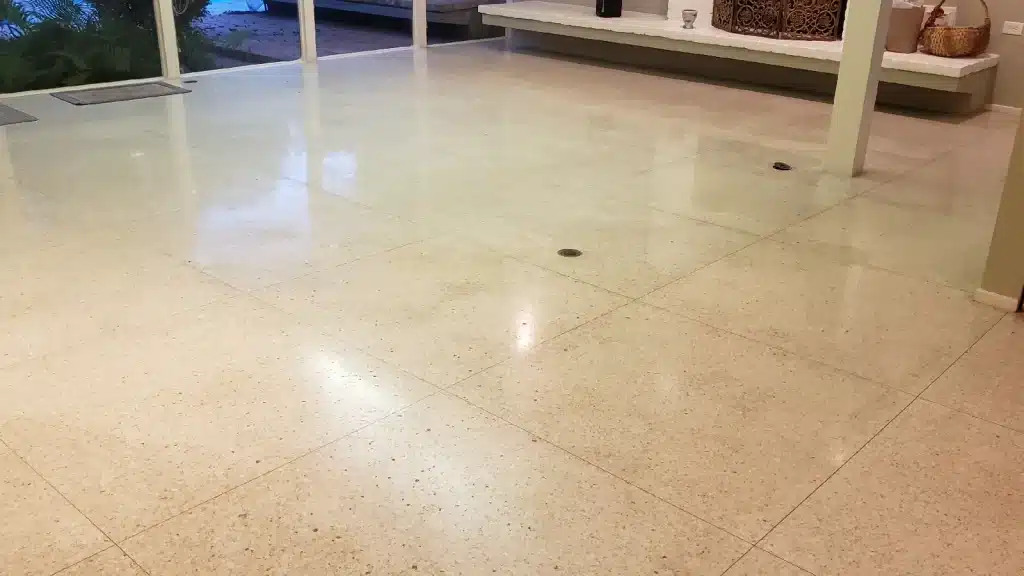
Living room terrazzo surface near kitchen showing wax buildup and surface wear prior to restoration. 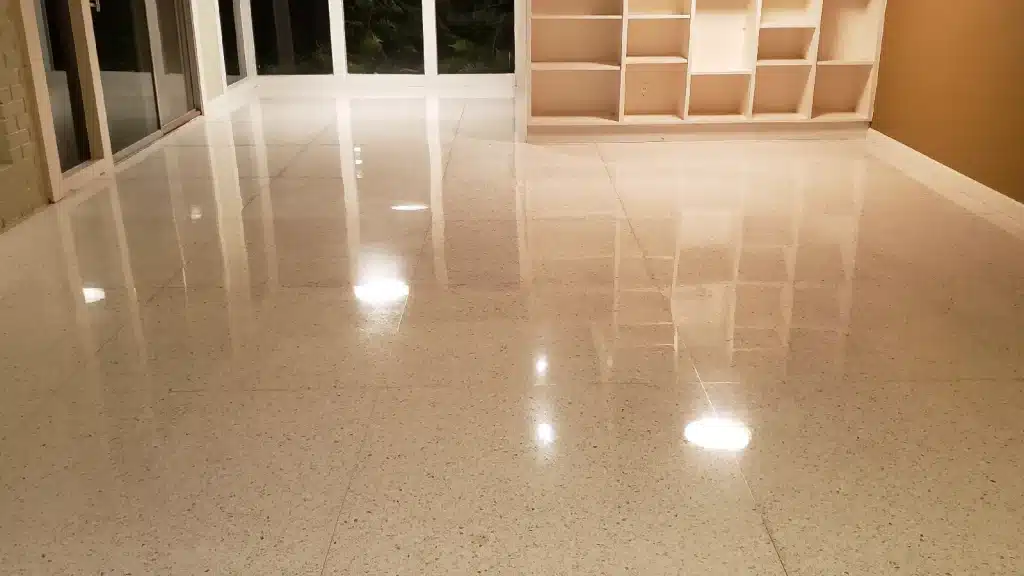
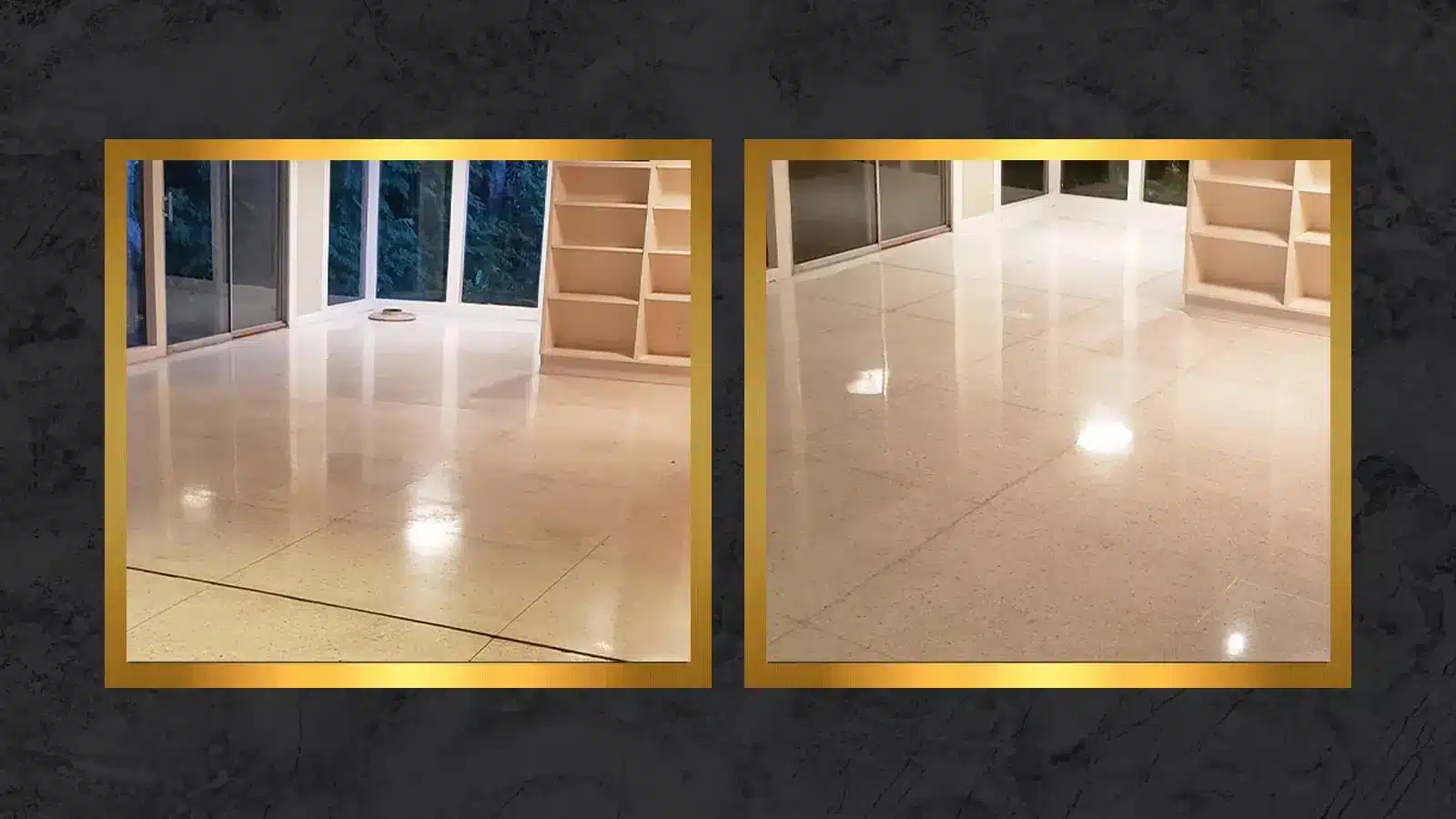
Alternate view of restored living room terrazzo showing uniform semi-gloss finish and repaired surface. 
Alternate view of living room terrazzo showing wax buildup and uneven surface sheen prior to restoration. 
Living room terrazzo surface after chip repair, wax removal, and semi-gloss mechanical polishing.