The Challenge
Terrazzo floor restoration Lake Jackson TX was required for a 3,000 square foot residential installation originally poured in 1958. The floor extended throughout the living room, family room, kitchen, hallways, and bedrooms. Decades of modifications, environmental exposure, and improper maintenance had significantly altered both the appearance and condition of the terrazzo surface.
The most visible issues included heavy yellowed wax buildup, multiple crack lines, scattered pinholes, and numerous mismatched patches where interior walls had previously been removed. These patch areas disrupted the visual continuity of the original aggregate blend and created uneven surface transitions. In several locations, residual divider strips were missing or improperly cut, further complicating repair planning.
The wax accumulation had created an artificial gloss that masked the true condition of the terrazzo beneath. The buildup was uneven, with areas of darkened discoloration and surface drag marks consistent with repeated topical reapplications. In addition, the home’s long-term exposure to Gulf Coast humidity contributed to a moisture-related condition described by the homeowner as “sweating.” While terrazzo itself is dense, trapped moisture beneath topical layers can create surface haze and staining over time.
Cracks were present in multiple rooms, varying from hairline shrinkage cracks to wider separation lines requiring structural filling. Pinholes and small voids were scattered throughout high-traffic areas. These defects were consistent with aging terrazzo installations and previous subfloor movement.
In certain sections, previous remodeling efforts had left exposed areas where walls once stood. These locations required removal of non-matching fill materials and fabrication of new terrazzo patches blended to match the original 1958 aggregate composition. Achieving visual consistency in aged terrazzo requires careful aggregate selection, cement matrix tinting, and controlled finishing to prevent visible repair outlines.
The scope of this terrazzo floor restoration Lake Jackson TX project extended beyond polishing. It required:
- Removal of decades of wax buildup
- Structural crack and pinhole repair
- Custom terrazzo infill installation
- Divider strip correction
- Full-surface grinding and refinement
- High-polish mechanical finishing
Because the terrazzo had not undergone a complete mechanical restoration in many years, the floor required aggressive initial grinding to expose clean aggregate and eliminate surface contamination. The size of the project—approximately 3,000 square feet—required phased grinding and polishing across multiple rooms over a 14-day restoration period.
This was not a maintenance-level polishing service. It was a comprehensive mechanical restoration and repair process designed to stabilize aging terrazzo while preserving its original mid-century character.
The Restoration Process
The terrazzo floor restoration Lake Jackson TX project began with removal of heavy wax buildup that had accumulated over decades. Chemical stripping alone was not sufficient due to the thickness and oxidation of the wax layers. Mechanical grinding was required to fully eliminate surface contamination and expose clean terrazzo.
Initial Grinding and Surface Exposure
A large planetary grinding machine was used to perform the initial cut across the 3,000 square foot installation. This stage removed residual wax, surface staining, and minor lippage while exposing the original aggregate structure beneath. Edge areas and room perimeters were addressed using hand grinders to ensure consistent depth of cut and eliminate uneven transitions between field and edge work.
Once the first cut was completed, the terrazzo’s true condition became visible. Cracks, pinholes, and prior patchwork were clearly defined and ready for structural correction.
Crack Repair and Pinhole Filling
Cracks were routed where necessary to create a clean bonding channel. A color-matched terrazzo repair matrix was installed to stabilize separation lines and prevent further propagation. Pinholes and surface voids were filled using compatible cementitious or resin-based fillers blended to match the surrounding matrix.
All repairs were allowed proper cure time before refinement continued. After curing, repaired areas were cut flush with the surrounding terrazzo to ensure a level surface plane.
Removal of Mismatched Wall Patches
Areas where interior walls had been removed presented one of the more complex challenges of this terrazzo floor restoration Lake Jackson TX project. Previous fill materials were inconsistent in aggregate size and coloration. These sections were cut out and removed.
Custom terrazzo patches were fabricated to replicate the original 1958 aggregate blend. Matching required careful selection of stone chips and tint adjustment within the cement matrix to approximate the aged appearance of the surrounding floor. Divider strips were reestablished where necessary to maintain visual continuity and structural separation.
Once cured, these custom patches were ground and blended into adjacent areas to minimize visible repair boundaries.
Progressive Honing and Refinement
After structural repairs were completed, the floor underwent progressive honing stages using increasingly finer diamond abrasives. Each stage removed the scratch pattern from the previous grit while refining surface clarity.
Because terrazzo contains both cement matrix and stone aggregate, uniform refinement requires balanced pressure and consistent tooling progression. Skipping grits or applying uneven pressure can result in differential polish between matrix and aggregate. Careful monitoring ensured even refinement across all rooms.
High-Polish Development
The final stages of terrazzo floor restoration Lake Jackson TX involved mechanical polishing to develop a high-polish finish. Polishing compounds and fine diamond abrasives were used to increase reflectivity and enhance aggregate clarity.
As the gloss developed, the terrazzo’s original mid-century character became increasingly visible. The polishing phase revealed depth within the aggregate that had been concealed beneath wax buildup for years.
No topical coatings were applied. The finish achieved was the result of mechanical polishing, not surface film application.
Final Cleaning and Sealing
Upon completion of polishing, the floor was thoroughly cleaned to remove slurry residue and fine dust. A penetrating impregnating sealer was applied to reduce liquid absorption while maintaining vapor transmission. Excess sealer was removed to prevent surface haze.
The terrazzo floor restoration Lake Jackson TX process required 14 days of phased work to complete structural repairs, custom infill fabrication, full grinding, and high-polish finishing across all 3,000 square feet.
The Results
The completed terrazzo floor restoration Lake Jackson TX project transformed a deteriorated 1958 installation into a structurally stabilized and mechanically polished surface spanning approximately 3,000 square feet.
Removal of decades of wax buildup eliminated the artificial yellowing and inconsistent sheen that had masked the terrazzo’s true composition. With the surface contamination fully removed, the natural aggregate distribution and cement matrix coloration became clearly visible. The high-polish finish was achieved through mechanical refinement rather than topical coatings, resulting in a reflective surface that remains breathable and maintainable.
Cracks that previously interrupted the visual continuity of the floor were stabilized and filled flush with the surrounding surface. Routed and repaired sections now present as integrated structural lines rather than open separations. Pinholes and minor voids were addressed across the installation, improving surface density and uniformity.
Areas where interior walls once stood were reconstructed using custom terrazzo patches blended to approximate the original 1958 aggregate composition. These infill sections were ground and polished level with the surrounding field, minimizing visible transitions. Divider strip corrections further improved alignment and restored structural definition where needed.
The high-polish development stage enhanced aggregate clarity while maintaining balanced reflectivity between stone chips and cement matrix. Light reflection is now consistent across living areas, hallways, kitchen, and bedrooms, without wax buildup or surface drag marks.
Moisture-related surface haze associated with prior topical layers has been eliminated. By removing non-breathable coatings and applying a penetrating impregnating sealer, the terrazzo system now allows normal vapor transmission while reducing liquid absorption at the surface.
Key outcomes of this terrazzo floor restoration Lake Jackson TX project include:
- Complete removal of oxidized wax buildup
- Structural crack stabilization and flush repairs
- Custom terrazzo patch fabrication and integration
- Uniform high-polish mechanical finish
- Restored aggregate clarity across 3,000 square feet
- Elimination of topical maintenance dependency
The restored terrazzo floor now reflects the original mid-century installation intent while remaining serviceable under modern maintenance practices. This project demonstrates how comprehensive mechanical restoration—combined with structural repair and custom infill fabrication—can extend the functional lifespan of historic terrazzo installations without the use of surface coatings.
This project involved comprehensive terrazzo floor restoration to remove heavy wax buildup, repair cracks and wall patch areas, and restore a high-polish mechanical finish. If you’d like to learn more about how terrazzo floor restoration can preserve and refine existing floors during renovation projects, you can explore our terrazzo services here.
Before & After Results
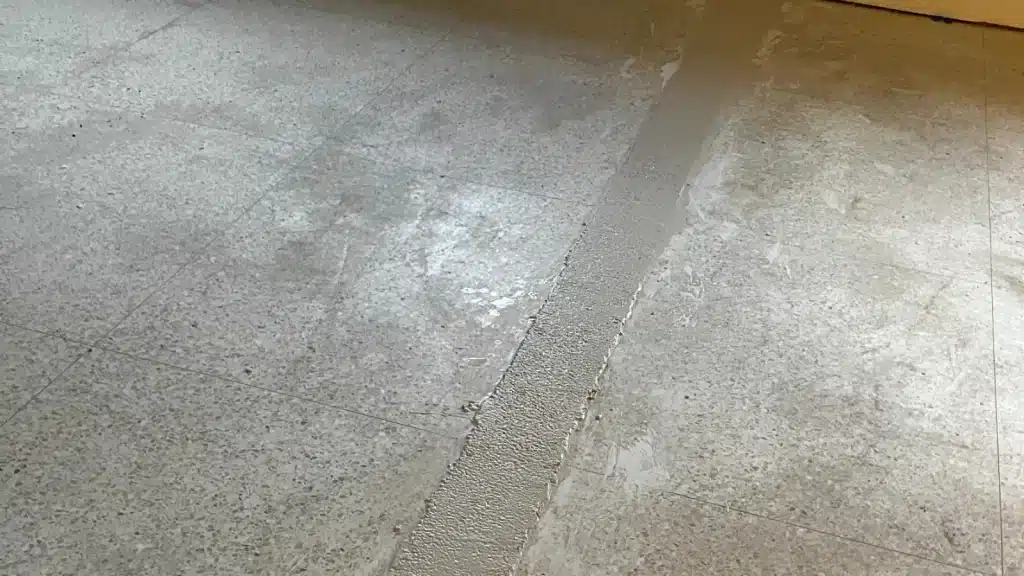
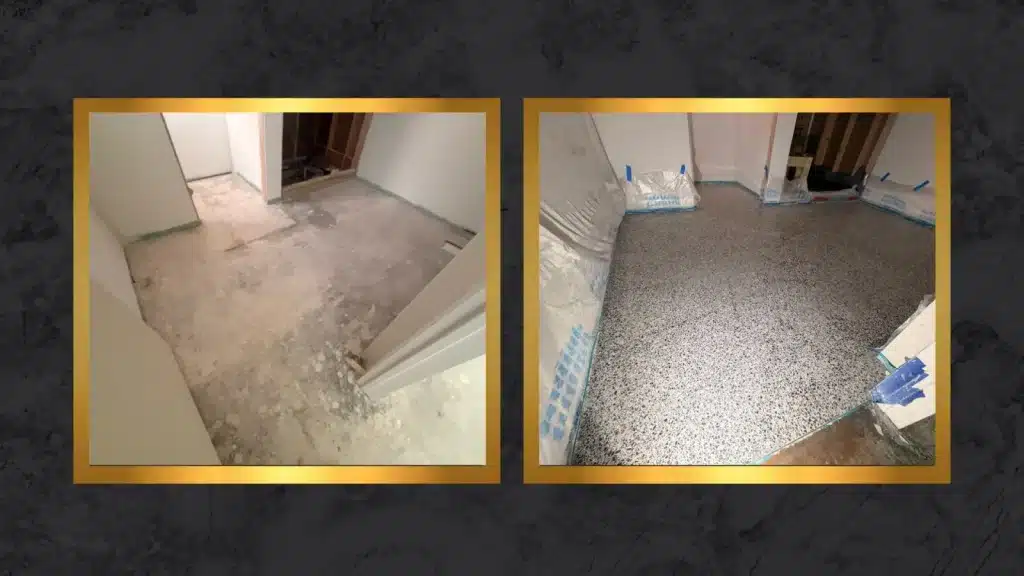
Original terrazzo surface prior to removal of mismatched wall patches and transition reconstruction. 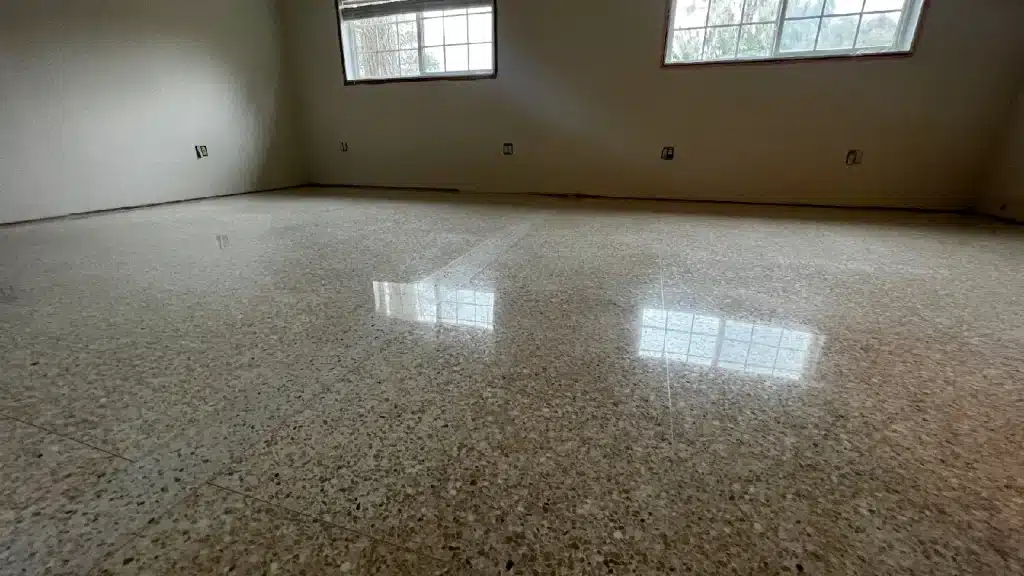
Master bedroom terrazzo surface after crack repair, custom patch integration, and high-polish mechanical finishing. 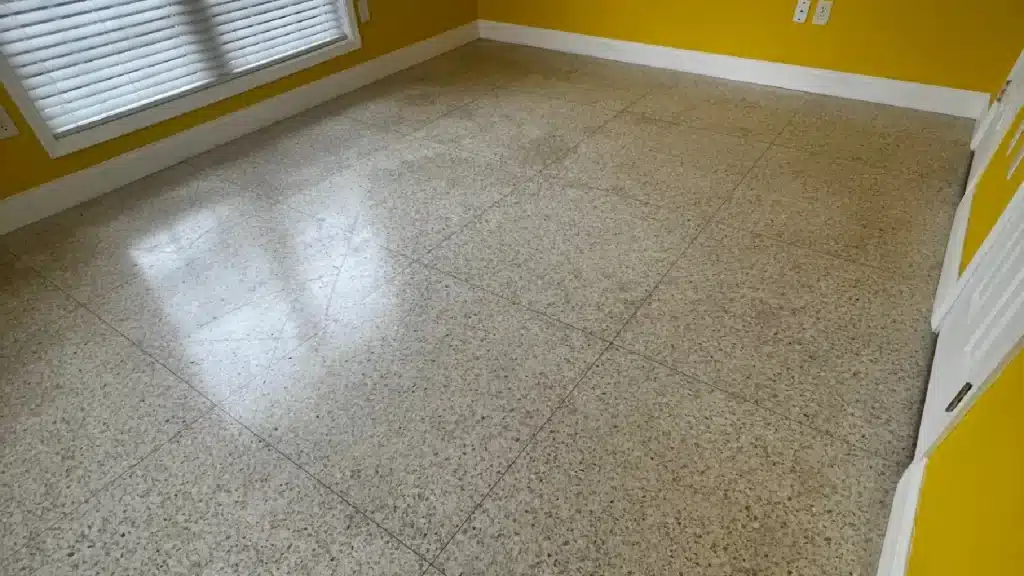
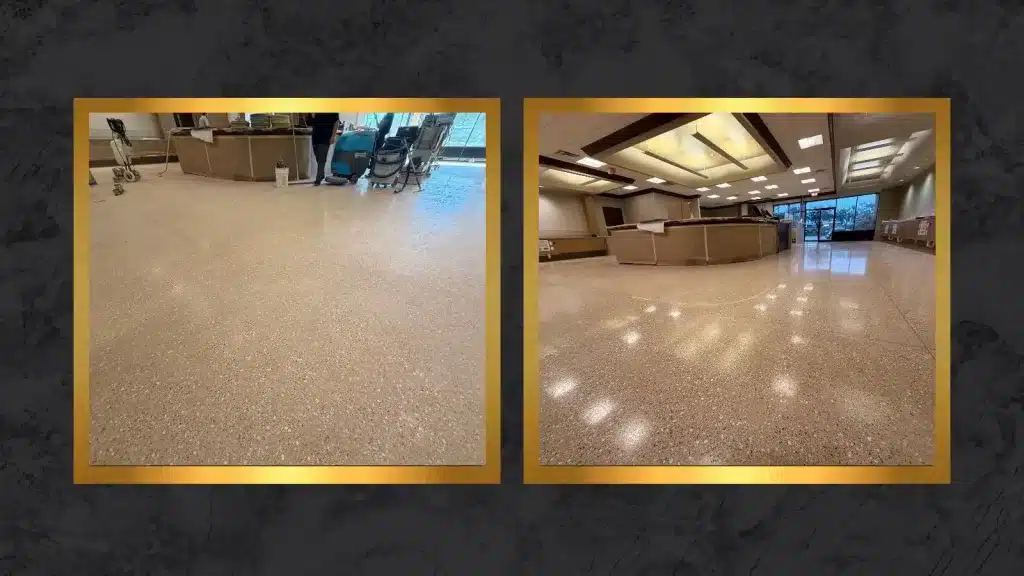
Surface showing oxidized wax accumulation and moisture-related haze prior to mechanical grinding. 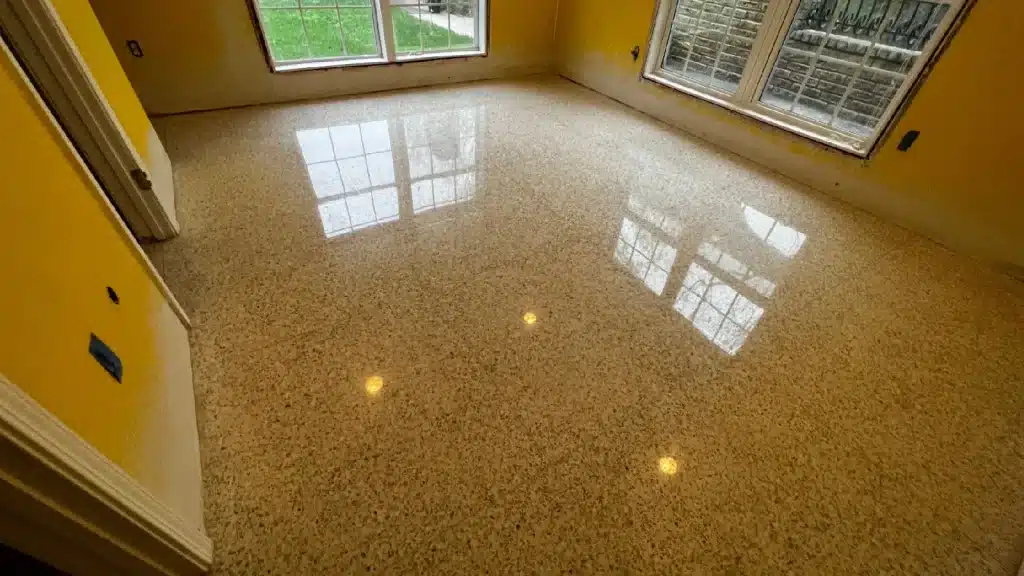
Completed terrazzo surface following crack repair, wax removal, and mechanical high-polish finishing. 
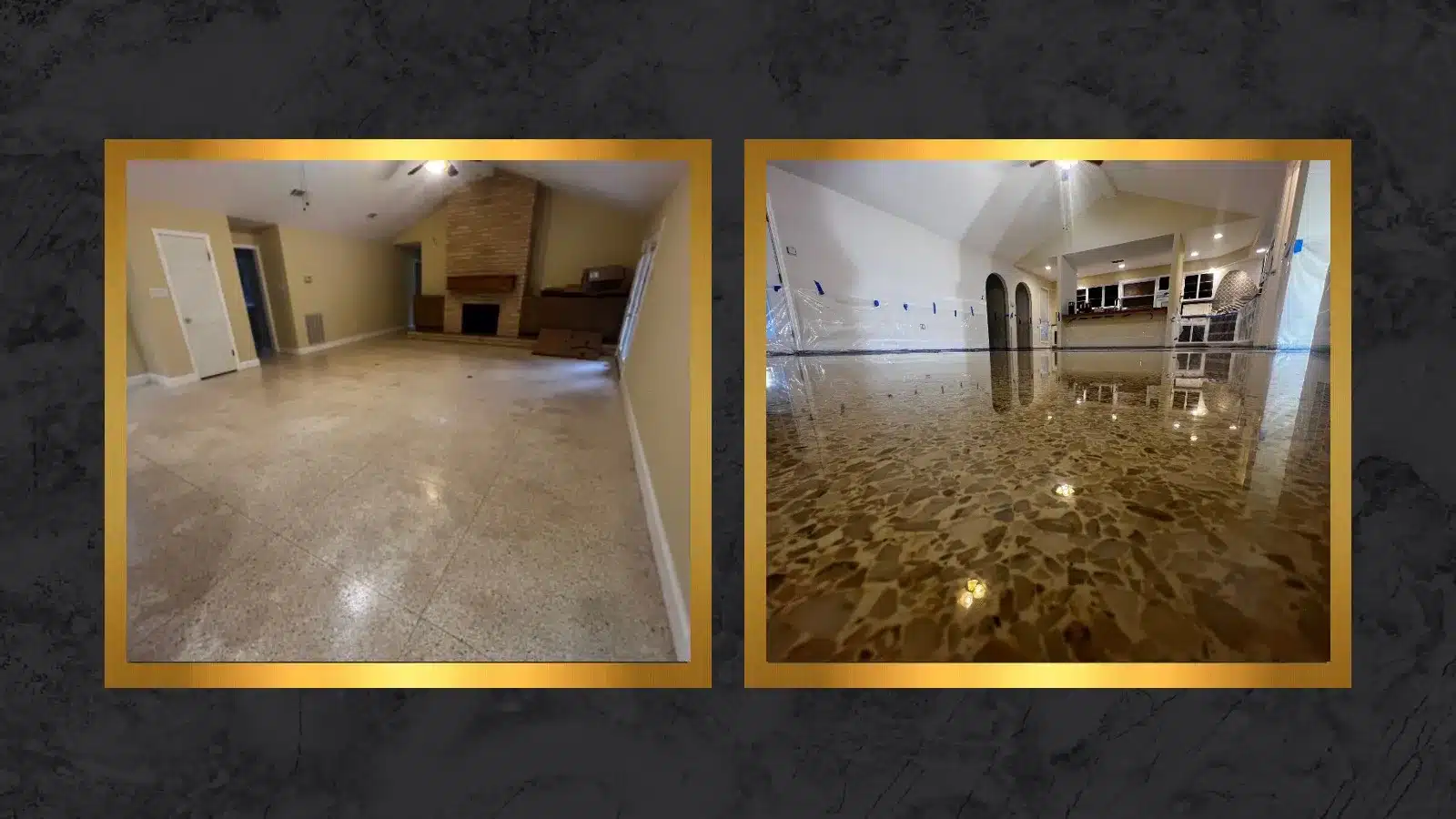
Family room terrazzo surface showing wax buildup, surface wear, and visible cracking prior to restoration. 
Family room terrazzo surface after full mechanical restoration and high-polish finishing.