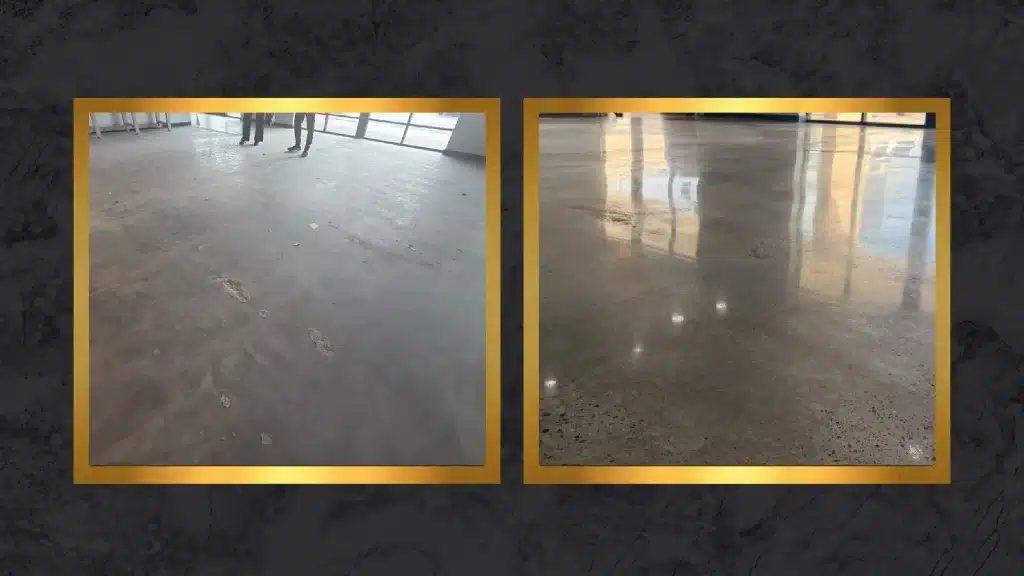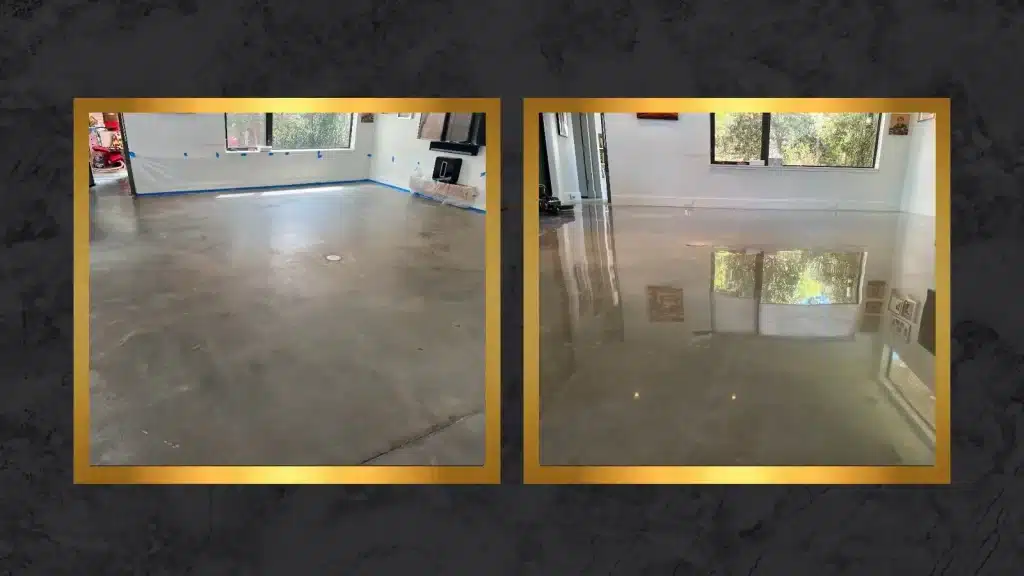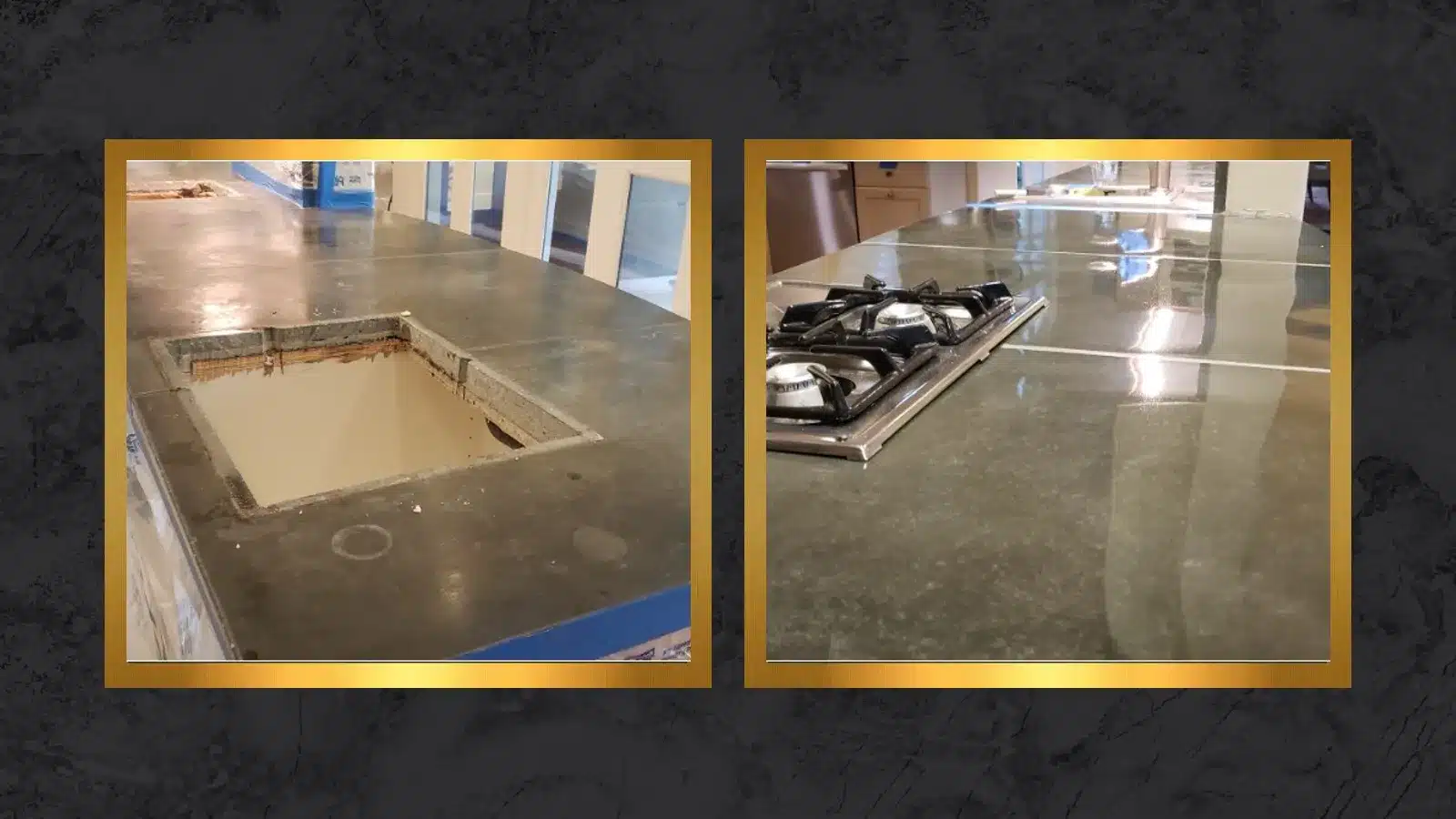
The Challenge
The Challenge
Concrete countertop restoration Houston TX was required after repeated exposure to acidic foods caused visible etching and surface dullness across the kitchen countertops. The homeowners reported that normal cooking activities—including cutting lemons, preparing meals, and routine food preparation—had gradually altered the appearance of the polished concrete.
Unlike staining, which affects surface coloration, acid etching chemically reacts with cement-based materials. Concrete countertops contain a cement matrix that is vulnerable to acidic substances. When lemon juice, vinegar, or similar ingredients remain on the surface, they can lightly dissolve the cement paste at a microscopic level. Over time, this reaction creates dull spots, irregular sheen patterns, and areas of reduced reflectivity.
In this case, the countertops displayed widespread etch marks concentrated around food preparation zones and sink areas. The polished finish had become inconsistent, with visible contrast between unaffected sections and acid-exposed areas. The surface no longer reflected light evenly, and attempts to clean or reseal the countertops did not resolve the problem.
It is important to note that sealers help reduce absorption but do not make concrete resistant to acid reaction. Once etching occurs, the damage is mechanical rather than topical. Simply applying additional sealer cannot restore gloss or smoothness. The affected surface must be mechanically refined to remove the etched layer and reestablish a uniform finish.
The client’s objective was to:
- Remove visible etching caused by acidic food exposure
- Restore clarity and consistent reflectivity
- Reestablish a polished finish suitable for kitchen use
- Apply appropriate protection following restoration
This concrete countertop restoration Houston TX project required controlled surface refinement and polishing rather than cleaning or resealing alone. The goal was to remove the damaged surface layer while preserving the integrity and thickness of the countertops.
The Restoration Process
The Restoration Process
The concrete countertop restoration Houston TX project began with a detailed evaluation of the etched areas to determine the depth and distribution of the surface damage. The etching was widespread but limited to the uppermost layer of the polished surface, making mechanical refinement a viable solution.
Surface Preparation
The countertops were thoroughly cleaned to remove residues, oils, and contaminants that could interfere with polishing. Protection was applied to adjacent cabinetry, walls, and fixtures to prevent dust migration during refinement.
Mechanical Refinement
To correct the etching, the surface was mechanically honed using diamond abrasives. This process removed a thin, uniform layer of material across the affected areas, eliminating the microscopic damage caused by acidic exposure. Care was taken to maintain flatness and avoid unnecessary material removal.
Because etching does not always occur evenly, certain zones required more refinement than others. The goal was to achieve consistent texture and clarity across the entire countertop rather than spot-treat isolated areas, which can create visible transitions.
Progressive Polishing
After the etched layer was removed, the surface was refined through progressively finer polishing stages. Each stage reduced the scratch pattern from the previous step and gradually restored reflectivity.
As the polishing progressed, the concrete regained a uniform sheen. Areas that previously appeared dull or cloudy began reflecting light evenly again. The final polishing stage established a consistent polished finish aligned with the client’s expectations.
Sealing
Once polishing was completed, the countertops were prepared for sealing. A penetrating sealer was applied to help reduce absorption and support ongoing maintenance. The sealer does not prevent acid reaction but helps limit staining and moisture intrusion under normal use conditions.
The concrete countertop restoration Houston TX process restored surface clarity and reflectivity by removing etched material rather than masking it. The finish achieved was mechanical, not topical, ensuring that the polished appearance was built into the surface itself.
The Results
The Results
The completed concrete countertop restoration Houston TX project eliminated visible acid etching and restored a consistent polished finish across the kitchen surfaces. Areas that previously appeared dull, cloudy, or uneven in sheen now reflect light uniformly.
By mechanically refining the surface rather than attempting to mask the damage, the etched layer was removed and replaced with a newly polished plane. The countertops now present a smooth, even texture without the irregular patterns caused by repeated exposure to acidic foods.
Transitions between previously affected and unaffected sections are no longer visible. The surface clarity is consistent across preparation areas, sink sections, and perimeter edges. The polished finish enhances the natural tonal variation within the concrete while maintaining controlled reflectivity appropriate for a residential kitchen.
Application of a penetrating sealer supports routine maintenance by reducing absorption, but the restored finish itself is mechanical. No topical coating was used to create artificial gloss.
Key outcomes of this concrete countertop restoration Houston TX project include:
- Removal of widespread acid etching
- Restoration of uniform surface clarity
- Even polished finish across all countertop sections
- Elimination of dull, reactive zones
- Stabilized surface prepared for routine maintenance
The countertops now reflect their intended polished appearance while remaining serviceable for daily kitchen use. This project demonstrates that acid-etched concrete surfaces can be corrected through controlled mechanical refinement rather than replacement.
This project involved professional concrete countertop restoration to remove acid etching from daily kitchen use and restore a polished finish. If you’d like to learn more about how concrete polishing can improve the appearance and long-term performance of concrete surfaces, you can explore our concrete polishing service here.
Before & After Results

Surface showing acid etching and dull areas caused by repeated exposure to lemon and cooking acids prior to restoration. 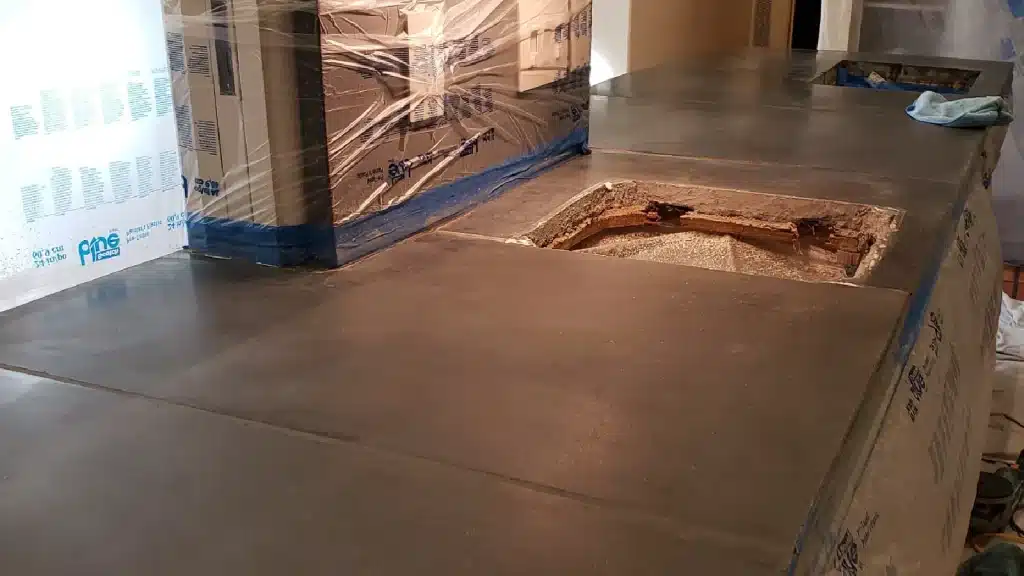
Concrete countertop after mechanical honing and polishing to remove acid etching and restore uniform reflectivity. 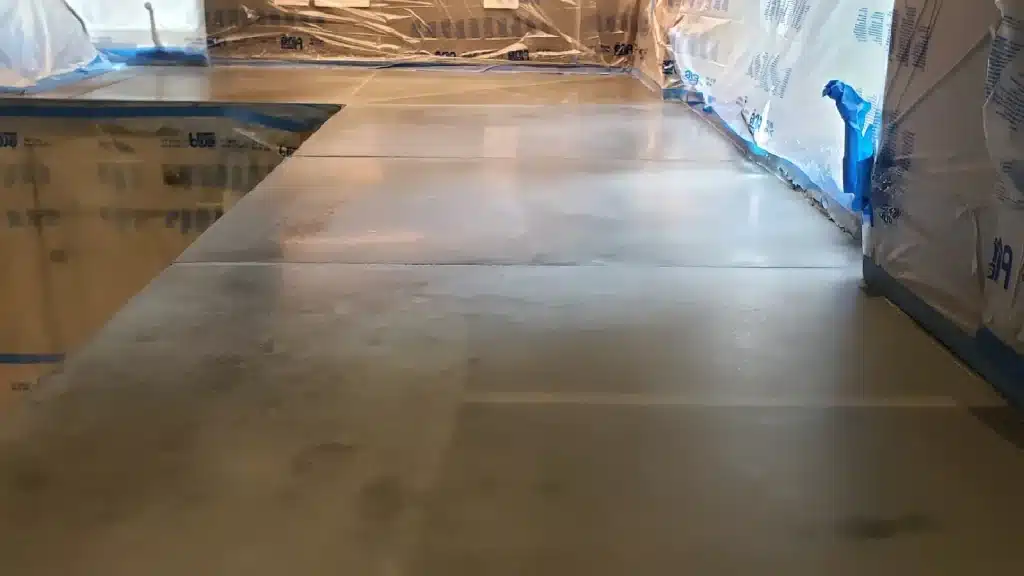
Polished concrete surface after etching removal and prior to application of protective sealer. 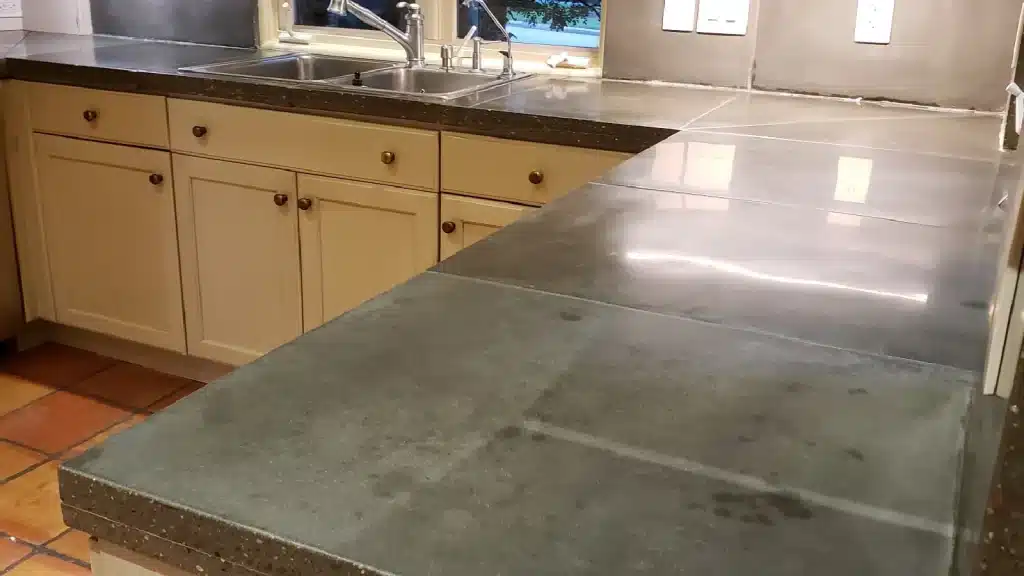
Surface condition after polishing to remove acid etching and before application of protective sealer. 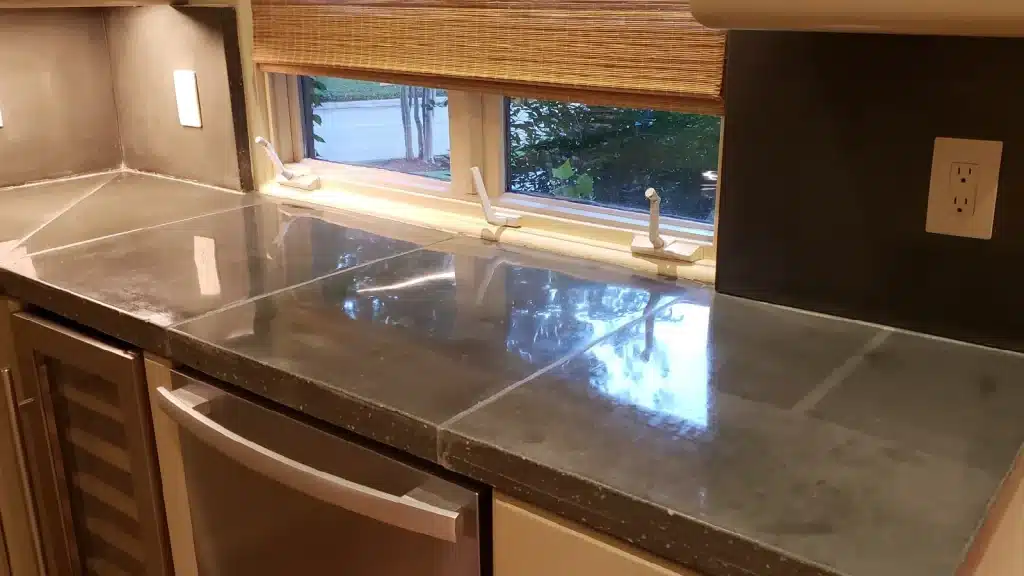
Final polished concrete countertop after acid etching removal and application of protective sealer. 
Kitchen-wide view of concrete countertops after acid etching removal, polishing, and protective sealing.