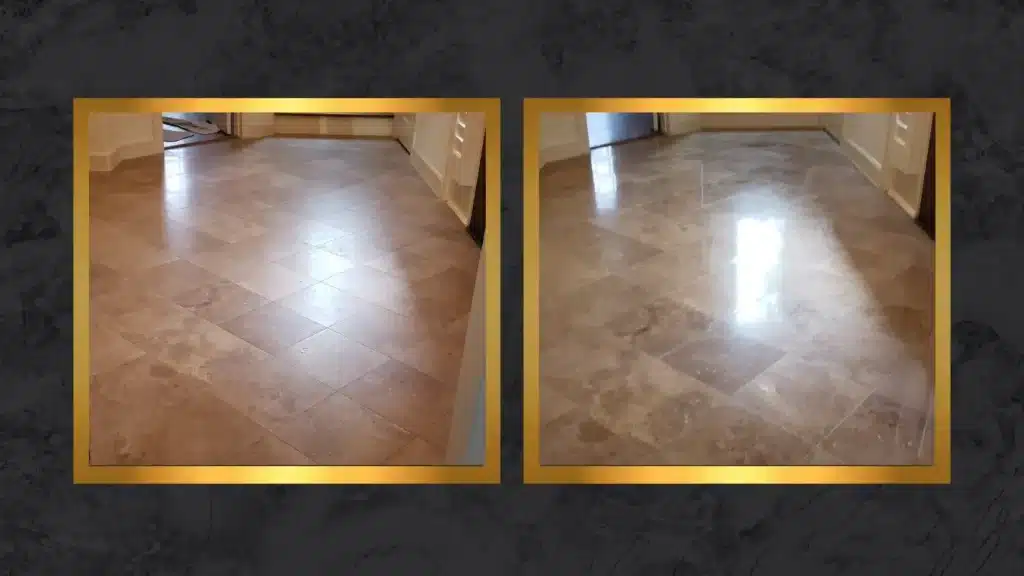
The Challenge
Travertine floor restoration and crack repair was required in this Humble, TX home after visible fracturing, surface wear, and loss of finish clarity affected the integrity and appearance of the stone. Over time, natural settling and foot traffic contributed to cracks and uneven wear patterns that disrupted the floor’s uniformity.
In addition to structural cracking, the travertine showed signs of surface etching and inconsistent sheen. The objective was to stabilize the damaged areas and restore a refined satin finish while preserving the natural character of the stone.
The Restoration Process
The restoration process began with a detailed evaluation of crack depth, substrate stability, and overall surface condition. Each crack was carefully repaired and stabilized to prevent further propagation and maintain structural continuity.
Following structural repairs, the floor was honed using progressively finer abrasives to remove surface scratches, etching, and uneven wear. Honing created a uniform surface plane across the installation and prepared the stone for refinement.
The travertine was then polished to a satin finish, enhancing clarity and restoring visual depth without introducing excessive gloss. This finish was selected to complement the home’s interior while maintaining a natural appearance.
The Results
After restoration, the travertine floor presented a clean, consistent appearance with stabilized cracks that blended naturally into the surrounding stone. The satin finish restored depth and warmth while maintaining a soft, non-reflective sheen.
Surface continuity was reestablished across previously worn areas, improving both visual consistency and overall usability. The completed restoration preserved the existing installation while enhancing long-term durability.
Why Travertine Floors Develop Cracks and Wear
Travertine is a naturally porous limestone that can develop cracks over time due to settling, structural movement, or concentrated traffic patterns. Unlike surface-level scratches, cracks require stabilization before aesthetic refinement can begin. Addressing both structural and surface concerns during restoration ensures the stone maintains its integrity while achieving a consistent finish.
Mechanical honing and polishing restore clarity by refining the stone itself rather than applying topical coatings. This process creates a more durable and maintainable surface compared to temporary surface treatments.
This project involved extensive crack repairs throughout the home, followed by polishing to restore clarity and achieve a semi-gloss finish.
If you’d like to learn more about how professional travertine restoration addresses cracking, wear, and surface dullness, you can explore our travertine restoration service here.
Before & After Results

Travertine floor before restoration showing cracking and surface damage. 
Travertine floor after crack repairs and surface preparation, prior to final polishing. 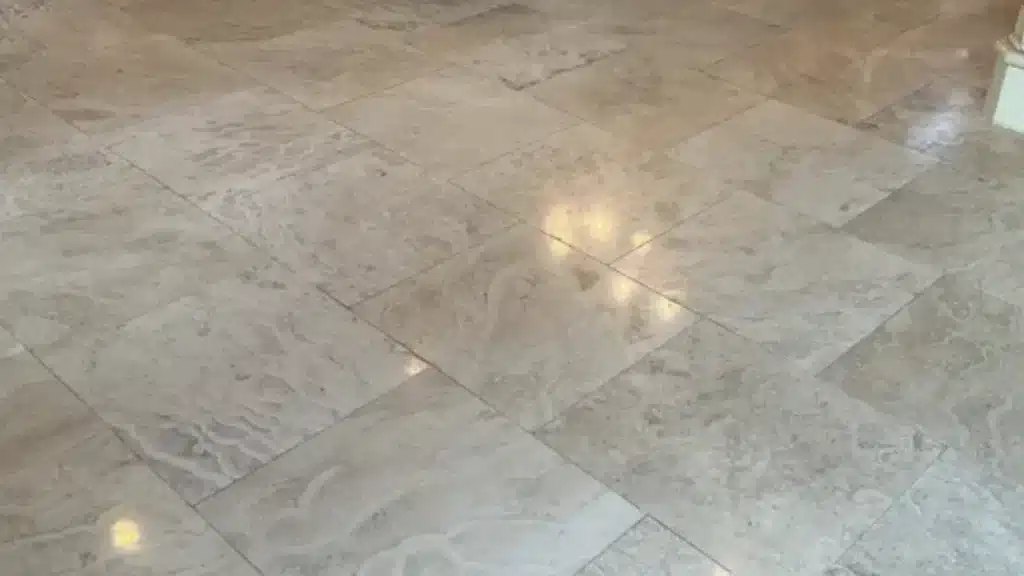
Final polished travertine floor with restored clarity and uniform finish. 
Family room travertine floor after crack repairs and polishing.